

Amid shifting resources and staffing across local authorities, the demand for efficient data collection, management, and reporting has never been greater.
Here, the Improvement Service highlights this practical example from Highland Council, where smart data use has strengthened planning and reporting processes.
The project
In the early 2000s, Highland Council’s research team developed a dedicated database to track housing completions within the council area. This database captures vital details about residential properties, including completion certificates (both full and temporary), house types, and locations.
Over time, this work has evolved to support an interactive completions dashboard and map, which now forms the backbone of several reporting products.
“The first thing we need to know within our area is where are the completions happening? In the past it would have been a case of visiting all these sites,” explained Mike Atkinson, Research Officer at Highland Council.
“When you’ve got an area like the Highlands it isn’t a sensible use of resources to go out and visit all areas – especially considering the distance to places such as Skye or Lochaber. We don’t want to be visiting sites; we want to get as much as we can virtually from the data sets that are already available.
“We now have a dataset of over 26,000 individual house completions. The last seven years are matched to the exact property location, while older records are linked to a nominal point within the building warrant application polygon.”
Some settlements have seen limited completions over recent years whilst other areas have had continuous delivery of new housing. So again, understanding what has been delivered is fundamental to understanding what needs to be delivered going forward - obviously with a range of other inputs like population change.
The benefits of this approach are substantial:
- Efficiency in Covering a Large Area: Extending over almost 26000 square kilometres the Highland Council area is vast. Relying on data already being recorded by building standards teams eliminates the need for additional site visits, saving significant time and resources.
- Reliable Trend Tracking: The database records over 20 years of data, enabling reliable analysis of trends in housing completions and providing valuable insights into the impacts of planning policies over time.
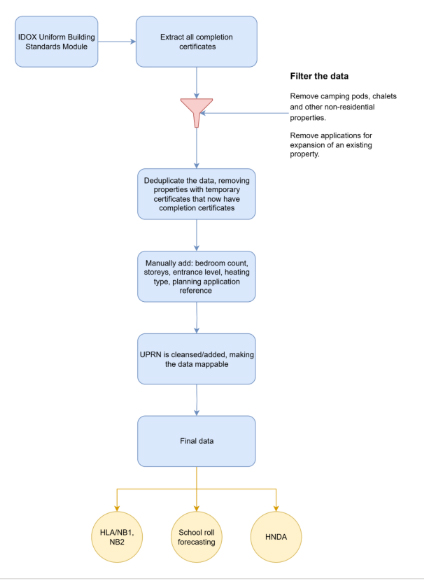
- Streamlined Government Reporting: Completions data is readily available for submission to the Scottish Government through NB1 and NB2 forms.
- Simplified Housing Land Audits: Annual and financial year monitoring of completions for Housing Land Audits (HLAs) is now a faster and more straightforward process.
- Enhanced School Roll Forecasting: Up-to-date data supports more accurate forecasting for school roll projections through clear understanding of completions in each school catchment area.
“Understanding what has been delivered is fundamental to understanding what needs to be delivered,” Mike added. “Some settlements have seen limited completions over recent years whilst other areas have had continuous delivery of new housing. So again, understanding what has been delivered is fundamental to understanding what needs to be delivered going forward - obviously with a range of other inputs like population change.”
The process
Each month, Highland Council follows a clear process: extracting housing completions data from building standards, validating it, and updating their suite of information products.
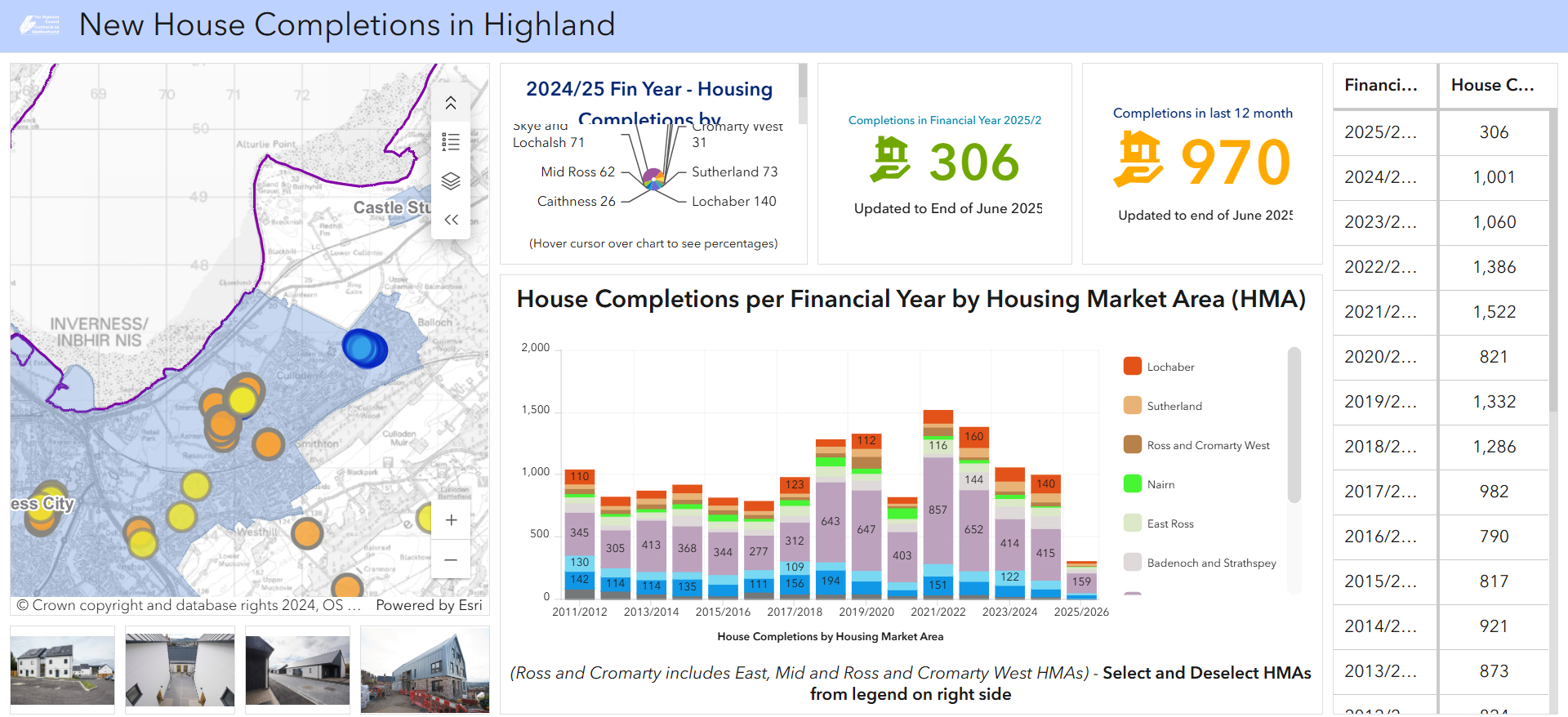
The new house completions dashboard stands out as a simple, interactive tool that makes it easy to understand spatial patterns of completions across the Highland Council area.
This dashboard democratises access to data, empowering users who may not have specialist mapping skills to explore and interpret housing trends.“The main benefit is being able to make information available from the local level to an aggregated area-based level,” Mike said.
"We can report back totals to the Scottish Government, but we can also inform people at that detailed local level of what has been delivered in their areas. More importantly, they can explore it interactively themselves at the click of a button.
"The system includes detailed geographic data, allowing users to drill down to the level of individual properties. Our goal is to provide a tool that lets people see how many properties have been delivered in a given area – and when.
"This evidence base directly informs planning and policy. For example, the data allows tracking of major housing development completions. When these completions pass a key trigger point, such as the 100th home in a new residential estate, specific developer obligation can be triggered, for example, the need for contributions to education," Mike explained.
“I was recently asked by the planner responsible to provide details of a specific housing delivery trigger point, and it was just an easy bit of analysis – order the completions on that site by date and there it is. That is pretty useful piece of evidence to present back to a developer when they suddenly become liable for a lot of money.”
This system offers a wide range of benefits, but its greatest strength lies in how it provides access to information. We're opening up the underlying data to everyone - from members of the public and councillors to external professionals and our own officers within Highland Council.
Looking ahead
Highland Council’s approach to automation and data-driven planning demonstrates the power of applying new processes to existing information to deliver real value for policy, planning, and community outcomes.
“Over the next five or 10 years I see it evolving. It needs to be much more automated – basically a push-button process to extract it,” Mike added. “At the moment we have far too many manual steps. All the elements are there to allow us to automate it, to make it more frequently updated and dynamic.
"This system offers a wide range of benefits, but its greatest strength lies in how it provides access to information. We're opening up the underlying data to everyone - from members of the public and councillors to external professionals and our own officers within Highland Council.
“It enables visibility at every scale, from local insights to aggregated data, all the way up to the strategic level of Council-wide service delivery."