


This case study explores the experiences of four Scottish local authorities that deliver Scottish Vocational Qualifications (SVQs) for the Early Learning and Childcare (ELC) workforce internally rather than through external providers. While most Scottish local authorities employ Modern Apprentices (MAs), only a small number have established the capability to deliver in-house qualifications through dedicated assessment teams.
At the time of writing, four local authorities are known to deliver SVQs in-house: Argyll and Bute, Highland, Midlothian, and South Lanarkshire. Moray Council previously delivered SVQs internally but no longer does so, having withdrawn from this approach due to sustainability and assessor capacity constraints. Figure 1 illustrates the current distribution of local authority approaches to in-house SVQ delivery across Scotland.
This distribution illustrates the diversity of local ELC workforce development approaches across Scotland and highlights that only a small proportion of councils have established the infrastructure required for in-house qualification delivery.
Drawing on conversations with Highland, South Lanarkshire, Argyll & Bute and Moray councils, this paper identifies the motivations behind internal delivery, the structures used to support it, and the perceived benefits and challenges. All findings are presented anonymously and thematically to support open reflection.
Key findings
- Internal delivery strengthens workforce pipelines. Local authorities report high levels of practitioner preparedness, confidence and retention among candidates trained internally, with many progressing to senior and leadership roles.
- Local pedagogy and expectations are embedded more effectively. Internal assessors understand the local authority’s curriculum, values and quality standards, supporting consistent practice across ELC settings.
- Existing staff benefit from accessible qualification routes. Some local authorities use their in-house model to support Early Years Support Assistants and unqualified practitioners in achieving SVQ Level 2 or 3 for SSSC registration.
- Internal delivery is cost-efficient. With Skills Development Scotland funding covering qualification delivery for eligible apprentices, costs centre primarily on assessment staffing. Local authorities delivering at scale report significant savings compared to purchasing SVQ provision from colleges or universities.
- Successful delivery depends on skilled assessment teams. Internal models rely heavily on small groups of experienced assessors. Loss of capacity poses a risk to sustainability.
- Geography shapes feasibility. Rural and island authorities face substantial logistical challenges, including long travel times and dispersed cohorts.
Internal SVQ delivery is not widespread across Scotland, but where it exists, it offers a powerful, contextually grounded model of workforce development. These programmes contribute to stronger recruitment pipelines, enhanced practitioner readiness, and deeper alignment with local pedagogical priorities. Their sustainability, however, requires stable investment, recognition of assessor expertise, and organisational commitment.
An on-site visit to South Lanarkshire Council’s long-established assessment centre was undertaken, including interviews with assessors and with current and former apprentices. This work forms the basis of the case study included as Appendix B.
A skilled, confident Early Learning and Childcare (ELC) workforce is central to Scotland’s ambition to deliver high-quality, nurturing and pedagogically rich experiences for children.
Introduction
A skilled, confident Early Learning and Childcare (ELC) workforce is central to Scotland’s ambition to deliver high-quality, nurturing and pedagogically rich experiences for children. Modern Apprenticeships (MAs) continue to represent a key entry route into the sector, supported by Skills Development Scotland (SDS) funding and underpinned by the requirement for apprentices to achieve a Scottish Vocational Qualification (SVQ) in Social Services (Children and Young People).
While most local authorities employ MAs, the qualification element is ordinarily delivered by external colleges or training providers. A small number of local authorities, however, have developed the capability to deliver SVQs internally, through dedicated Learning and Development (L&D) or assessment teams. These internal models support both MAs and, in some areas, existing ELC staff who require SVQ Level 2 or 3 qualifications for Scottish Social Services Council (SSSC) registration.
At the time of writing, four local authorities are known to deliver SVQs in-house: Argyll and Bute, Highland, Midlothian, and South Lanarkshire. Moray Council previously delivered SVQs internally but no longer does so, having withdrawn from this approach due to sustainability and assessor capacity constraints.
This paper draws on conversations with four councils, Highland, South Lanarkshire, Argyll & Bute and Moray, to explore their experiences of internal SVQ delivery. All findings are presented anonymously and thematically to encourage open reflection and avoid scrutiny of individual practice. The analysis highlights the value of these models, the challenges associated with sustaining them, and the potential lessons for wider workforce development.
An on-site visit to South Lanarkshire Council’s assessment centre was undertaken, including interviews with assessors and with current and former apprentices. This work forms the basis of the case study included as Appendix B.
Short contextual summaries of the participating local authorities are included in Appendix A.
Approach
The insights presented here draw on a series of conversations with local authority leads and improvement officers. These conversations explored:
- The origins and rationale for internal qualification delivery;
- Operational structures and delivery models;
- Approaches to supporting apprentices and existing staff;
- Perceived strengths, impacts and challenges; and
- Sustainability considerations and future direction.
The purpose of this work was not to assess performance or compare models, but rather to understand how internal assessment teams function and what value they bring to local ELC workforce systems.
Verbatim quotations are included where they illuminate key findings without identifying councils.
In addition to conversations with local authority leads, a site visit was undertaken to one local authority assessment centre. This included in-person discussions with assessors and with both current and former apprentices. These conversations provided richer insight into day-to-day assessment practice, the relational aspects of in-house delivery, and the lived experience of candidates progressing through local authority–delivered SVQs. Insights from this visit inform the thematic analysis throughout the report and are further explored in the accompanying case study.
If we want people to stay, we need to grow them here. Training them ourselves is the most reliable way to do that.
Why delivery in-house?
Although internal delivery emerged from different local histories, several consistent motivations were identified.
3.1 Building a sand reliable workforce pipeline
Internal assessment models are seen as an investment in workforce stability. Councils described the need to cultivate their own practitioners to address recurring recruitment challenges, enhance continuity, and support long-term workforce planning.
One council reflected:
“If we want people to stay, we need to grow them here. Training them ourselves is the most reliable way to do that.”
This approach is particularly valued in rural or island communities where access to external training is limited or inconsistent.
3.2 Embedding local approaches to pedagogy and practice
Local authorities consistently emphasised the value of aligning qualification training with local expectations, curriculum approaches and organisational culture. Internal assessors understand the local authority’s pedagogical frameworks and quality standards, allowing candidates to learn in the environment in which they will ultimately work. All of the local authorities we spoke to had assessors who had a wealth of knowledge and experience of working in early years.
As one assessor reflected, internal delivery enables the authority to go “beyond teaching the SVQ framework,” supporting candidates to develop a deep understanding of the principles and practices that underpin early years provision locally. This alignment between learning, assessment and organisational ethos was described as a key factor in ensuring practitioners enter the workforce with clarity, confidence and a strong sense of the authority’s expectations.
3.3 Providing accessible qualification routes for existing staff
Internal SVQ delivery is not restricted to MAs. Some local authorities use their assessment teams to support:
- Early Years Support Assistants requiring SVQ Level 2
- Existing unqualified practitioners requiring SVQ Level 3
These routes are often inaccessible or costly through external providers, especially in remote areas. Internal delivery enables local authorities to support staff progression while meeting SSSC registration requirements.
Local authorities emphasised that quality must be balanced carefully with scale.
How internal delivery works
Although the scale, history and structure of internal delivery vary, several shared components were identified.
4.1 Assessment teams
Internal delivery relies on small, specialist teams, typically two to five staff, who possess:
- Significant ELC experience;
- Assessor qualifications;
- Knowledge of local pedagogy;
- Capacity for workplace assessment; and
- An ability to build strong relationships with candidates.
Their professional credibility and trainee support were repeatedly described as critical to programme success.
4.2 Blended learning and assessment
Delivery models commonly include:
- Online learning via MS Teams or similar platforms;
- Planned in-person observations;
- Scheduled study time off the floor;
- Structured development days; and
- Peer networking sessions.
This flexibility is essential in geographically dispersed local authorities, allowing assessors to balance remote and on-site engagement.
4.3 Placement and experience design
Local authorities use different approaches to placement design but share similar aims:
- Ensure high-quality mentoring;
- Provide experience across age ranges where possible;
- Expose candidates to specialist practice (e.g., outdoor pedagogy, under 2s); and
- Align placements with future workforce needs.
Several local authorities are developing rotation models to broaden candidate experience across all age groups.
4.4 Scale and programme structure
Annual intake sizes vary significantly, from small cohorts of around four to large programmes exceeding 50 apprentices.
Cohort size is determined by:
- Workforce demand;
- Available salary budget;
- Assessor capacity; and
- Access to SDS-funded places
Local authorities emphasised that quality must be balanced carefully with scale.
Some of our earliest apprentices are now leading teams. That’s the long-term impact.
What difference does internal delivery make?
Several key recurring benefits were identified across all local authorities.
5.1 Practitioners who are well prepared for practice
Local authorities consistently reported that internally trained practitioners demonstrate:
- Strong alignment with local expectations;
- High levels of confidence in practice;
- Deeper understanding of their role; and
- Readiness to contribute from day one.
These qualities were attributed to close, ongoing assessor relationships and learning embedded in real practice environments. Observations and discussions during a site visit to a local authority assessment centre, including conversations with assessors and current and former apprentices, reinforced these findings, particularly in relation to confidence, readiness for practice and the ability to apply learning in real-world ELC settings.
5.2 Improved recruitment, retention and progression
Local authorities provided numerous examples of apprentices progressing through the workforce, with some now in leadership roles.
“Some of our earliest apprentices are now leading teams. That’s the long-term impact.”
Internal delivery supports predictable workforce planning by growing practitioners with strong local commitment.
5.2 Cost Efficiency
Councils generally view internal delivery as cost-effective. SDS funding covers the qualification element for eligible apprentices, and costs beyond assessor staffing are low.
One local authority noted substantial savings:
“Before bringing delivery in-house, we paid around £600–£700 per apprentice to the college.”
At scale, internal delivery is significantly more economical.
The programme works because of the people. Losing even one assessor would place significant pressure on the model.
Challenges and considerations for sustainability
6.1 Dependence on small, specialist teams
Internal models rely heavily on the stability and expertise of a small number of assessors.
“The programme works because of the people. Losing even one assessor would place significant pressure on the model.”
One local authority discontinued internal delivery primarily due to assessor capacity constraints.
6.2 Funding for MA salaries and limited support for SVQ Level 2
Although SDS funds qualification delivery for MAs, councils must meet salary costs. This directly limits cohort sizes.
Local authorities also highlighted the absence of SDS funding for Level 2, despite demand among Early Years Support Assistants.
6.3 Geographic and logistical barriers
Rural and island local authorities face unique challenges:
- Extensive travel for assessment;
- Limited placement options; and
- Difficulty building peer networks.
Despite the geographical spread of one local authority, assessors reported that the blended learning model has enabled them to maintain consistency of support across remote settings. Their reflections illustrate that, although geography remains a barrier, internal delivery can mitigate some logistical pressures when supported by flexible assessment approaches.
By reducing travel requirements for both candidates and assessors and utilising in-house assessors rather than external college provision, we have achieved substantial savings while enhancing the learner experience.
Sector-level insights
Several broader insights emerge from this work:
7.1 Internal delivery can be a highly effective workforce strategy
Where conditions allow, internal delivery strengthens workforce pipelines, supports progression, and embeds local pedagogical approaches.
7.2 Sustainability depends on stable investment and team capacity
Small assessment teams require support, succession planning and recognition of their specialist contribution.
7.3 A diversity of local models is appropriate
No single approach will meet the needs of every community. Local context, particularly geography, shapes the best delivery model.
7.4 Relational practice is central to success
Strong assessor–candidate relationships underpin confidence, motivation and successful outcomes. The accompanying case study provides a practical illustration of how these relational approaches operate on the ground and the conditions required to sustain them over time. These themes are illustrated in depth through the South Lanarkshire case study in Appendix B.
7.5 Cost efficiency
Highland council notes that internal delivery has resulted in notable cost efficiencies within the local authority. They commented:
“By reducing travel requirements for both candidates and assessors and utilising in-house assessors rather than external college provision, we have achieved substantial savings while enhancing the learner experience.”
Conclusion
In-house SVQ delivery represents a distinctive but valuable approach within Scotland’s ELC workforce system. Although adopted by relatively few authorities, internal delivery offers several meaningful benefits: enhanced practitioner readiness, stronger workforce pipelines, improved retention, and teaching that is closely aligned with local pedagogy and expectations.
Its sustainability, however, depends on skilled assessor teams, stable investment, and organisational commitment. As Scotland continues to build a high-quality and resilient ELC workforce, these insights offer important learning for local and national policy development.
Appendix A: Local authority summaries
Highland Council
Highland Council has delivered in-house SVQ Level 3 qualifications for Modern Apprentices (MAs) since 2019, training around 50 apprentices annually. The programme is delivered by a stable team of experienced ELC assessors who also support existing staff requiring qualifications for SSSC registration. Delivery is structured, time-bound and blended, using MS Teams, monthly meetings and in-person observations. Highland is approved to deliver SVQ Level 2, but current SDS funding constraints limit this offer. The programme is regarded as positive, efficient, and well-integrated with the central Early Years team.
Argyll & Bute Council
Argyll and Bute Council delivers SVQ qualifications for the Early Learning and Childcare workforce through an in-house assessment model linked to its Modern Apprenticeship programme. Apprentices are employed within ELC settings and complete their SVQ through a combination of workplace assessment, structured support and development activity. Delivery is shaped by the local authority’s geographic context, with a strong emphasis on blended approaches and flexible assessment arrangements to support candidates across rural and island communities. Internal delivery is viewed as a practical way to strengthen local workforce pipelines, support consistent practice, and mitigate challenges associated with accessing external training provision in a geographically dispersed authority.
South Lanarkshire Council
South Lanarkshire operates one of Scotland’s longest-running local authority assessment centres, established around 2001. The team delivers SVQ Level 3 for Modern Apprentices and SVQ Level 2 for Early Years Support Assistants, alongside funded Level 3 qualifications for other staff. Apprentices gain experience across multiple settings and receive both theoretical training and workplace assessment. Recruitment is strong, and long-term outcomes include progression into practitioner, team leader and senior leadership roles. The model is recognised as a mature, robust system with long-standing impact.
Moray Council
Moray Council has experience delivering SVQs internally, but no longer does so. The first cohort, delivered in partnership with the University of the Highlands and Islands (UHI) , demonstrated strong retention in the ELC workforce. A later attempt to deliver the SVQ through the council’s own social work training team was hindered by limited assessor capacity. Moray now commissions all SVQ delivery externally through UHI but continues to employ Modern Apprentices and values the model as a workforce entry route.
Appendix B: Growing our own in South Lanarkshire: assessor-led SVQs in early learning and childcare
How Assessor-Led, In-House SVQ Delivery Supports Confident and Capable ELC Practitioners
Purpose of this case study
This case study explores how South Lanarkshire Council delivers Scottish Vocational Qualifications (SVQs) for the Early Learning and Childcare (ELC) workforce through an in-house assessment centre. It focuses on the people who make this model work: the assessors.
Drawing on a visit to the assessment centre and conversations with assessors, alongside discussions with current and former apprentices, the case study aims to show how assessor-led delivery, built on strong relationships and deep understanding of candidates, supports confidence, progression and long-term workforce development.
Wider context
Across Scotland, most local authorities employ Modern Apprentices in ELC but rely on colleges or external providers to deliver the SVQ element. Only a small number of authorities, including South Lanarkshire, deliver SVQs internally through dedicated assessment teams.
South Lanarkshire’s model is long-established and closely linked to the local authority’s wider approach to workforce development. It sits alongside a strong Foundation Apprenticeship (FA) programme, delivered through local secondary schools, which provides an early introduction to ELC for young people and creates a clear progression route into Modern Apprenticeships.
Many of the Modern Apprentices supported through the assessment centre have previously completed a Foundation Apprenticeship while at school. Assessors described this as a significant strength of the local system, as candidates often arrive with a realistic understanding of the role and greater confidence in working within an ELC setting.
The programme currently includes eight new Modern Apprentices starting in April, nine progression Modern Apprentices, and a further five due to start in March. In addition, there are 21 existing Level 2 candidates currently undertaking their qualification.
She had her wall up… she wouldn’t let you in. But eventually she realised I wasn’t here to make it harder for her, I was here to support her. I am so proud of where she is today.
The assessors and their role
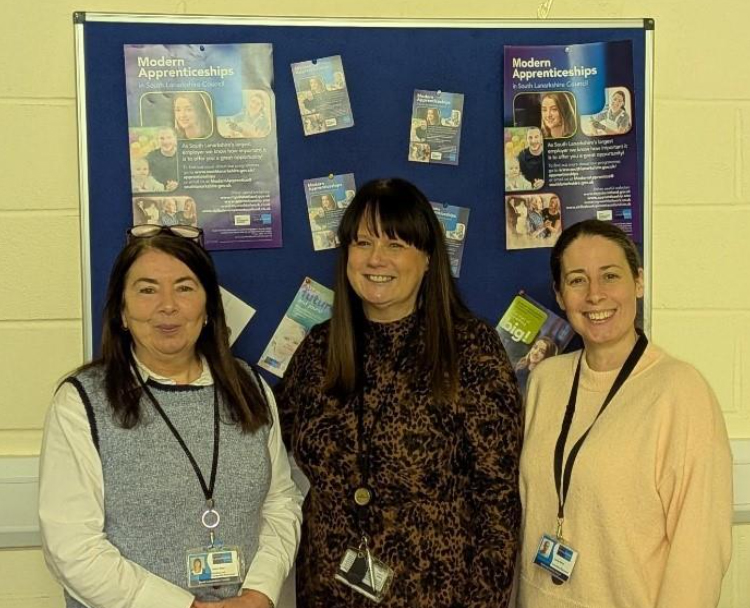 At the heart of South Lanarkshire’s in-house model is a small, experienced team of four assessors based in Hamilton. They have extensive backgrounds in early years practice and have moved into assessment roles over time. The team consists of Pauline Myers, Lesley Moffat, Debra Miller and Ashleigh Kinloch. They are supported by Janice Hamilton, a former assessor, who carried out the reviews and recruitment.
While most assessors had progressed into the role following long careers in early years practice, one assessor described moving into the team from a leisure background, working previously with older children. The team reflected positively on the value of bringing different professional perspectives into the assessment centre, highlighting how shared learning and collaboration support both assessor development and consistency in delivery.
Collectively they repeatedly emphasised that their role is not simply to assess evidence. Instead, they are supporting people through a learning journey. One assessor described how candidates can initially arrive guarded or unsure:
“She had her wall up… she wouldn’t let you in. But eventually she realised I wasn’t here to make it harder for her, I was here to support her. I am so proud of where she is today.”
Building that trust is seen as essential. Assessors explained that many candidates come with low confidence or difficult experiences of school, and that early relationship-building allows candidates to engage more openly with learning.
The assessors are not external checkers or box-tickers. Instead, their role is supportive, relational and developmental. They are responsible not only for assessment, but also for:
- Designing learning materials and guidance;
- Shaping how the qualification is delivered; and
- Supporting candidates through challenges.
Assessors spoke about the importance of being visible, approachable and consistent. Regular contact throughout the qualification, typically visiting candidates in settings every three to four weeks, allows them to understand each individual’s strengths, confidence and learning needs. Over time, this continuity helps candidates see assessors as a consistent source of support rather than judgement.
Learning through practice: how candidates experience the qualification
“When you’re writing stuff up, you’re writing about everything you’re doing. It’s real life.”
A consistent theme across conversations with apprentices was that learning through daily practice made the qualification feel more accessible and meaningful.
Candidates described how working in the setting during the day and completing coursework afterwards allowed them to reflect on real situations, rather than relying on theoretical examples.
One apprentice explained that written assignments felt easier because they were grounded in real experiences.
Rather than learning concepts in isolation and then trying to apply them later, candidates were able to immediately connect learning to their own interactions with children and families. This helped them understand why particular approaches mattered, rather than simply learning what the theory said.
“It’s not the scenarios that they put in the books...when you actually have to deal with it, it’s completely different.”
Several apprentices contrasted this with how they imagined learning would feel in a college-only route. They described concern that learning through theory alone would have felt disconnected from practice.
Assessors also recognised this as a strength of the in-house model. Because candidates were employed within settings while completing the qualification, learning was continuous. Observation, reflection and discussion happened alongside practice, allowing assessors to link qualification requirements directly to what candidates were already doing.
This approach was particularly important for candidates who had struggled with traditional classroom learning. For apprentices who found it difficult to learn through sitting at a desk or working primarily from written material, learning through doing, discussing and reflecting felt more natural and engaging. The apprenticeship route allowed knowledge and understanding to develop through practice first, with written work following as reflection rather than abstraction.
For these candidates, the apprenticeship route allowed them to demonstrate knowledge and understanding through practice first, with written work following as reflection rather than abstraction.
The ability to immediately apply learning and then reflect on it within coursework was described as one of the most valuable aspects of the programme.
By designing learning materials, building trusted relationships and supporting candidates through challenges, assessors help apprentices move from uncertainty to confidence, and from learning to leadership.
Understanding candidates and adapting support
Assessors spoke frequently about the importance of understanding how each candidate learns. They described asking early on about experiences of school and encouraging candidates to share if they struggled with learning or confidence. This understanding allows assessors to tailor how learning is delivered while maintaining standards. The focus is on removing barriers rather than reducing expectations. Assessors described adapting their approach by talking through requirements rather than relying solely on written guidance, breaking tasks into manageable steps, and adjusting pacing when candidates experience pressures outside work. This flexibility was seen as essential given that apprentices are working full-time while completing their qualification.
Pride in progression and long-term impact
A strong theme across assessor conversations was pride in seeing candidates progress beyond the apprenticeship itself. Assessors spoke about watching individuals move through different stages of their career over time - from Foundation Apprentices at school, to Modern Apprentices, to qualified practitioners and leaders. South Lanarkshire now has examples of setting leaders who have progressed through the in-house qualification route. Assessors described this as one of the most rewarding aspects of their work, demonstrating the long-term value of investing in people locally. For assessors, success is not simply completing a qualification. It is seeing candidates remain in the sector, grow in confidence, and eventually support others in the same way.
Conclusion
This case study shows that the strength of South Lanarkshire’s in-house SVQ delivery lies in the assessors themselves. Their experience, professional judgement and commitment to understanding candidates allow learning to be adapted without compromising standards. By designing learning materials, building trusted relationships and supporting candidates through challenges, assessors help apprentices move from uncertainty to confidence, and from learning to leadership. The insights offer valuable learning for local authorities and partners considering how assessment, when shaped by those who understand practice, can play a central role in developing the ELC workforce.
For more information or to get in touch, please email elc@improvementservice.org.uk or check out our website https://www.improvementservice.org.uk/products-and-services/transformation-and-improvement/early-learning-and-childcare