


Isabella Williams Project Officer, Child Poverty Project Officer, and Mia Duncan, Community Wealth Building Project Officer, discuss how we can tackle child poverty through Community Wealth Building.
Too many children in Scotland grow up in poverty. The most recent multi-year figures put the relative child poverty rate at 21% (2022-25), that’s more than one in five children. Behind that number are families whose resources don't stretch to cover the basics, in communities across every local authority in Scotland.
The case for action rests on three grounds: moral, legal and economic. The moral case is straightforward and widely shared: no child should grow up hungry and without access to basic needs. The legal case is enshrined under the Child Poverty (Scotland) Act 2017. The Scottish Government must reduce relative child poverty to below 10% by 2030/31, and local authorities and health boards must jointly publish annual reports on what they are doing, and what they plan to do, to reduce child poverty in their area.
The economic case is the one most often left implicit, so it's worth stating plainly. Child poverty is not only a hardship to be relieved after the fact; it is a feature of how the local economy distributes wealth: who earns what, who owns what, and how much wealth generated in local places is retained there. Tackling it sustainably means preventing concentrated patterns of wealth from developing and sustaining, rather than topping up household incomes to re-dress inequality after-the-fact. That is precisely what Community Wealth Building is about.
What community wealth building does
CWB is a globally recognised economic development model aimed at addressing deep-rooted systemic challenges faced by local, regional, and national economies. It does so by examining how wealth is created, circulated, and distributed, with the aim to transform how the economy works more democratically for the people, places and planet it is meant to serve.
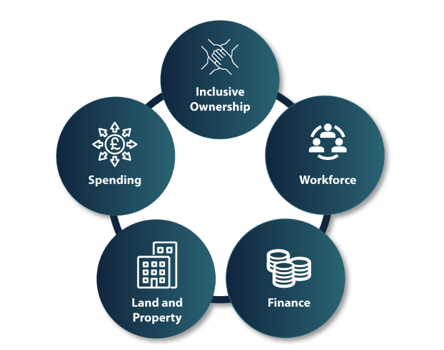
Using a structured five-pillar model, CWB focuses on practical, intentional actions to keep more wealth within communities. This includes generating fair work opportunities, supporting the growth of local businesses and inclusive business models, and transferring more wealth into the hands of local people and communities.
In March 2026 the Community Wealth Building (Scotland) Act was passed unanimously by the Scottish Parliament. The Act aims to ensure that local authorities and other parts of the public sector implement community wealth building across Scotland. It does this by placing duties on Scottish Ministers and various public bodies, particularly local authorities. These duties relate to the publication and implementation of statements, action plans and guidance.
Where the two agendas meet
Both agendas are, at their core, about reducing inequality. Child poverty policy primarily approaches this by raising the level of household resources and targeting priority families at highest risk of poverty. CWB approaches it by asking how the local economy operates, who owns its different parts, and how concentrated patterns of wealth can be disrupted. This is sometimes called pre-distribution. CWB tries to restructure the way the economy works so that wealth isn't concentrated in a few hands in the first place. Both, in other words, try to change how the system behaves, towards something fairer with a focus on preventing families from falling into poverty.
That shared logic lets us map the drivers of child poverty onto CWB. The three recognised drivers are income from employment, income from social security, and the cost of living.
Income from employment directly links to the Workforce pillar. Promoting real living wages, building in-work progression routes into better-paid roles, and creating workplaces that support parents into employment all raise earned incomes. Notably, ‘Bringing Hope, Building Futures’ the Tackling Child Poverty Delivery Plan 2026–2031 identifies the introduction of the CWB Act itself as an action taken to increase earned incomes.
Cost of living maps onto the Finance pillar and the Inclusive Ownership pillars. Growing non-extractive finance such as credit unions and community banks widens access to affordable credit. Moving more assets into community ownership (through the Inclusive Ownership and Land and Assets pillars) helps families to save. There are opportunities to take this further: community-owned energy schemes, for instance, can reinvest profits into childcare, fuel-poverty payments or training.
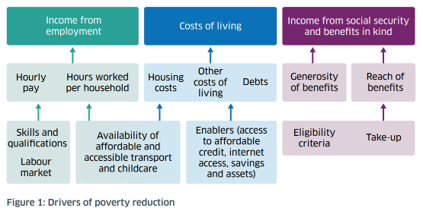
Income from social security is the driver CWB reaches least directly. But through a functioning CWB model, households will benefit in ways that reduce their need for social security. By boosting income from employment and reducing costs (i.e. the other two drivers), CWB can help lessen pressure on household budgets, and improve local access to advice services.
A practice example – The life chances model
The Life Chances model is an approach developed by Fife Council to tackle socio-economic disadvantage by opening up guaranteed, ring-fenced job opportunities for people, including families in the priority groups, facing barriers to work.
Instead of traditional recruitment, the model creates supported paid placements. These are delivered in partnership with organisations such as NHS Fife, Fife Gingerbread, Fife Sports and Leisure Trust, and third‑sector groups, to help participants build confidence, skills, and work experience.
The programme seeks to support those who find it difficult to overcome labour market challenges (such as long-term unemployment, little or no work experience, living in a jobless household, lone parents) to progress into fair, sustainable work. Crucially for the child poverty agenda, some of those participants are parents: a parent moved into secure, fairly paid work is a household with more income, which is one of the most direct routes to lifting a child out of poverty. The model tackles the "income from employment" driver and strengthens the local economy at the same time.
Opportunities for local authority practitioners
Local authorities and Health Boards share a joint statutory duty to write, publish and implement both CWB and Local Child Poverty Action Reports (LCPAR). While LCPAR’s are published annually and the first local or regional CWB plans will be published within 3 years of the act coming into force, and then reviewed every 5 years thereafter, there is an opportunity to ensure these plans are aligned and supporting one another. As identified above there are many shared aims across the agendas, and this could be reflected in local authority and partner plans.
Because of this shared aim around reducing local inequality, these plans will likely be looking to use some of the same contextual data to baseline activity around and measure progress. This presents an opportunity for local authority officers and child poverty leads to support each other in gathering, sharing, and reporting this data, as well as capitalise on the advance of child poverty data tools where strong examples of local practice are emerging, particularly around the identification of local high-risk areas, and households within the priority groups.
There is an opportunity to embed CWB and deepen the role of local authorities and health boards as anchors within LCPARs, so that the plans reference and reinforce one another, rather than duplicating or describing an initiative twice. This might mean setting out how anchor levers, such as employment and the use of land and assets, will be applied to reduce child poverty. Likewise, wider child poverty levers, such as transport and childcare, are enabling conditions that support access to fair work and participation in the local economy, aligning with the CWB approach.
Child poverty leads and CWB leads could work together early so that these connections are designed and scaled deliberately to support both agendas.
Aligning these agendas to transform local economies and improve outcomes for families is perhaps the fastest route not only to reducing child poverty, but to preventing it in the first place. It also means doing the work once, with more impact, to achieve a mutual goal: a local economy that works for the families who need it most, so that fewer children grow up in poverty within communities that share wealth more fairly.