




In 2023, West Lothian Council (WLC) and the Improvement Service (IS) began work on a project to identify unmet need for council-provided education-related support, namely free school meals, clothing grants, and educational maintenance allowance. The goal was to analyse the data by comparing with child poverty rates to show where uptake was less than might be expected.
The success of this project led to a successful bid to the Child Poverty Accelerator Fund to build on the project by exploring new datasets to be included in the analysis, presenting the analysis in a more engaging way, and allowing the lessons to be put into practice. One year on from the beginning of the project, the project team provides an update on our progress to date and reflects on the lessons learned along the way, as well as next steps.
Progress to date
One of the core aims of the project is to work with WLC to access further data. We have made good progress in this area and have been able to access several new datasets to allow us to understand poverty within West Lothian, including Housing Arrears and Housing Benefit, Foodbank services, Universal Credit uptake, and Advice Service statistics.
Another key aim of the project is to deliver an interactive dashboard to allow users to explore the data. Early on we engaged with other councils to understand what works in developing a dashboard like this. The key lesson, and something that has been repeated by other stakeholders, is to keep it simple. Taking that onboard, the dashboard focuses on clearly identifying areas with unmet need within West Lothian. Users can then explore a detailed breakdown of the data for individual areas.
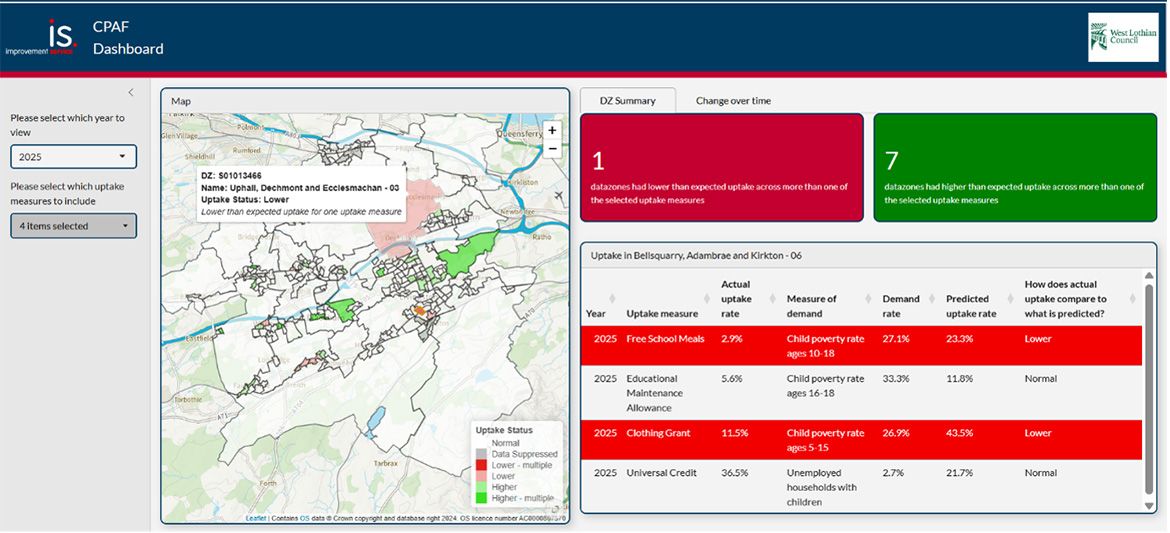
West Lothian Council now have access to a working version of the dashboard which they have used to identify areas where uptake is different to what is expected. Using this information, council officers have made visits to these areas and working with local community groups have started to develop plans for targeted interventions.
Challenges/lessons
As might be expected, accessing some datasets has been challenging, but steady progress has been made. As part of the project all of the routes for accessing data, whether that’s anonymising or completing a data sharing agreement, are recorded and we plan to work with other councils in future to understand how accessible the same or similar datasets are across Scotland.
Another lesson learned has been the value of having a feedback loop between the IS as analysts and WLC as practitioners and subject experts. The dialogue between our organisations about what is needed to put the findings of the analysis into practice and what’s possible with the data we have has been invaluable.
Assessing impact is something we are keenly aware will be crucial to the success of the project. The project evaluator, A Place in Childhood, have been incredibly helpful in supporting us to think about how we can measure and understand impact. Over time we will look to build measurement indicators into our dashboard and allow us to understand what’s working.
Lastly, we have drawn on expertise from across academia, local government, and the wider public sector through an external reference group. This has allowed us to draw on a huge amount of expertise to discuss the issues we face and make the most of the data we have. As mentioned above, this has been particularly useful in designing our dashboard, with a focus on simplicity and impact.
Next steps
The IS and WLC are continuing to work to identify and access more data and move towards a final version of the dashboard. The next phase of the project will be exploratory work around scaling this project to other areas in Scotland. That will primarily mean accessing the same datasets as we are using in WLC, capturing and sharing lessons from the work “on the ground” in WLC, and developing dashboards for other areas. We are currently seeking volunteers to help with this next phase.
If your local authority would be interested in taking part, get in touch.