





Early Learning and Childcare
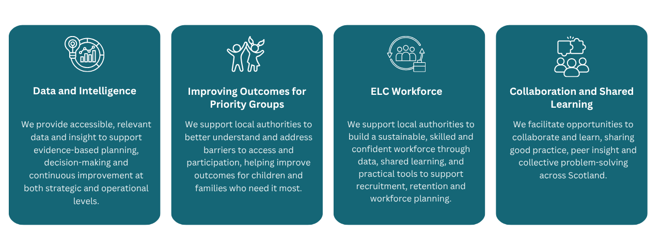
The ELC team has recently refreshed its team offer to ensure it reflects the evolving needs and priorities of Scotland’s Early Learning and Childcare sector. As the policy and delivery landscape continues to develop, the team has taken the opportunity to clearly articulate how it supports the Scottish Government, local authorities and sector partners to strengthen, enable and assure high-quality, sustainable ELC services.
Central to the refreshed offer is the teams ongoing commitment to acting as a trusted critical friend to local authorities, providing constructive challenge, practical support and opportunities for shared learning. This updated offer provides greater clarity on the team’s area of focus and the support available to stakeholders as they respond to both current priorities and emerging challenges across the ELC sector.
Workforce
Supporting new ELC leaders to thrive in Glasgow
This latest case study explores how Glasgow City Council, in partnership with the University of Glasgow, has developed an innovative mentoring programme to support colleagues. Discover how the programme is strengthening leadership, building confidence and supporting succession planning across the ELC workforce.
Fairer Futures Partnership
New briefings published by the Improvement Service are highlighting Glasgow’s pioneering work to tackle child poverty through public service reform.
Produced in partnership with the Glasgow Child Poverty Programme and the Scottish Government, the briefing series captures key learning from Glasgow’s ambitious city-wide initiative, which is testing new approaches to reducing child and family poverty through systemic change.
Child Poverty Data Information Session: Summary Report
This report summarises the Child Poverty Data Information Session held on Tuesday 19th May, bringing together colleagues from local authorities, the Scottish Government, the Improvement Service and partner organisations. The session explored how data can be used more effectively to understand need, identify families who may benefit from support, and improve outcomes for children and families experiencing or at risk of poverty. It highlights emerging national initiatives, opportunities for collaboration, and practical actions to support better data sharing and service delivery across Scotland.
Fairer Futures Partnerships Spotlight Session: No Wrong Door Approaches
This report summarises learning from the Fairer Futures Partnerships (FFP) Spotlight Session on No Wrong Door Approaches, held on Thursday 4th June 2026. It brings together reflections, examples of practice, and key learning shared by partners across Scotland, with particular insights from North Ayrshire and West Dunbartonshire.
The report highlights the importance of person-centred, joined-up support, strong partnership working, data sharing, and early intervention in ensuring people can access the right help at the right time. It also explores the opportunities and challenges involved in embedding a No Wrong Door approach and provides practical examples to support further learning and development across Fairer Futures Partnerships.
Action Learning Set Programme: Additional Support Needs in Early Learning and Childcare
The Improvement Service is facilitating a series of Action Learning Sets designed to bring together a small cohort of professionals from across the Early Learning and Childcare sector to explore the opportunities and challenges associated with supporting children with Additional Support Needs (ASN).
The programme will provide a structured space for reflection, peer learning and collaborative inquiry, with a focus on strengthening inclusive practice, supporting early intervention and improving outcomes for children and families.