


Community wealth building (CWB) is a globally recognised economic development model aimed at addressing deep-rooted systemic challenges faced by local, regional, and national economies.
It does so by examining how wealth is created, circulated, and distributed. Using a structured five-pillar model, CWB focuses on practical, intentional actions to keep more wealth within communities. This includes generating fair work opportunities, supporting the growth of local businesses and inclusive business models, and transferring more assets into the hands of local people and communities. The goal is to ensure that collective wealth serves people, places, and the planet more effectively.
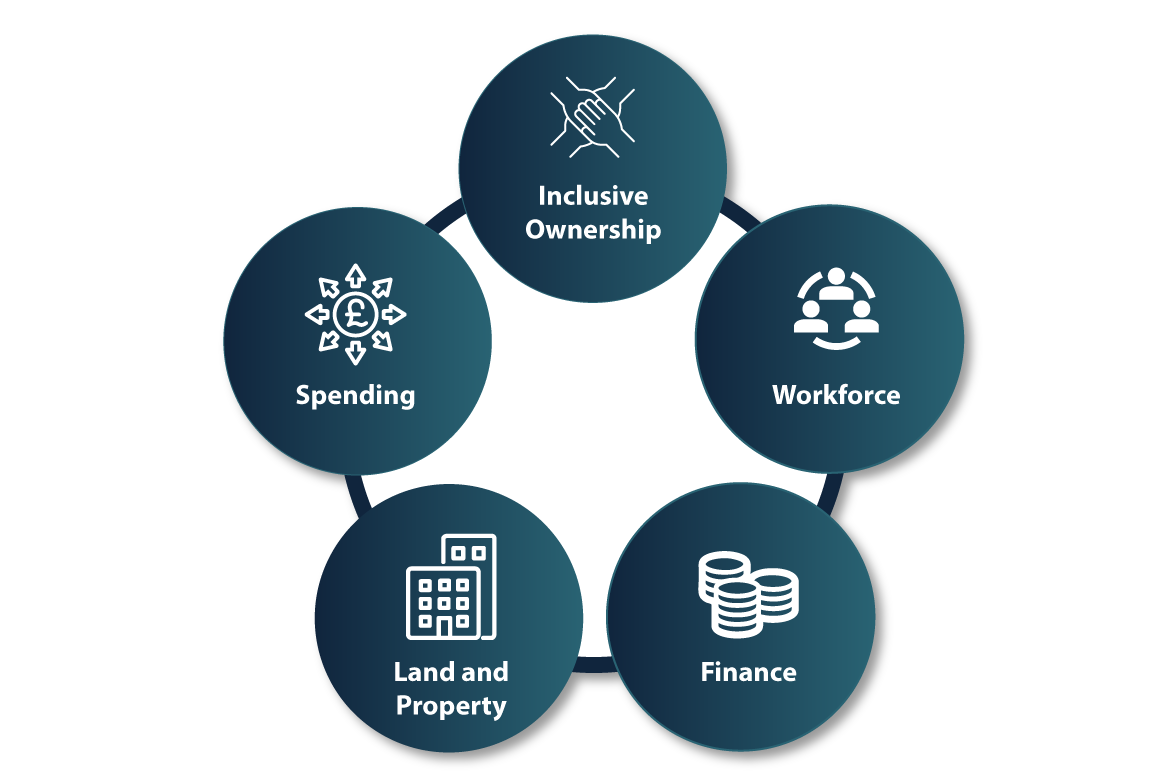
The five pillars:
- Inclusive ownership - promoting employee-owned business, co-operatives, and social enterprises to ensure community wealth is generated and retained locally.
- Workforce – Increase and prioritize fair wages and foster local labour markets.
- Finance - Ensure investment flows and financial institutions cater to the needs of local people, businesses, and communities.
- Land and Property - Leverage land and property assets to create social, economic, and ecological value. Increase community ownership and benefit from land and property.
- Spending - Maximise community benefits through local procurement and commissioning.
CWB and the wellbeing economy in Scotland
The Scottish Government has adopted the internationally recognised community wealth building (CWB) approach to economic development as a key practical means by which progress can be made towards realising our wellbeing economy vision outlined in the National Strategy for Economic Transformation (NSET). Several local authorities have already led the way participating in Scottish Government-supported pilots to create community wealth building action plans, with similar work undertaken in local authorities across the country in advance of the forthcoming bill.
Improvement Service CWB Project
To support Scotland’s community wealth building (CWB) journey, the IS Community Wealth Building Project is committed to helping local authorities implement CWB initiatives. It provides secretariat support for a community wealth building practitioners network, facilitating knowledge-sharing and collaboration on common challenges. In addition to these efforts, the project seeks to deliver a comprehensive and up-to-date overview of CWB implementation across Scotland while strengthening connections between CWB and other policy areas.
To learn more about the project or collaborate, email mia.duncan@improvementservice.org.uk
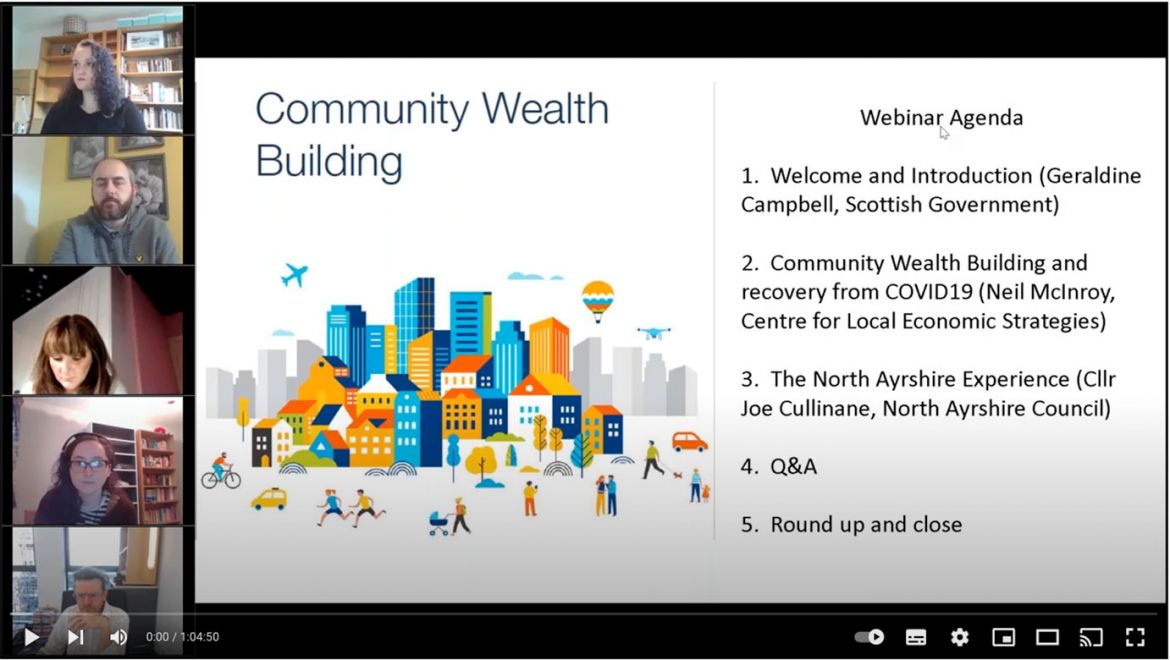
We have produced an elected member briefing on community wealth building and there are two useful presentations in the videos below.
A series of case studies of community wealth building practice across Scotland.
East Lothian Council and Queen Margaret University Lead the Way
East Lothian Council has established the East Lothian CWB Charter and subsequent Working Group which comprises signatories of the Charter and supporting partners. Communicating the CWB vision has inspired anchor organisations, who are exploring how CWB aligns with their own activities and how they can contribute to embedding it in their settings. Queen Margaret University (QMU) is one such anchor.
The City of Edinburgh Council: Developing a CWB Framework for Granton Waterfront Regeneration
The Granton Waterfront regeneration is a major long-term project led by the City of Edinburgh Council to transform a former industrial area on the shores of the Firth of Forth into a vibrant, sustainable coastal community. The Community Wealth Building Framework was developed to support the long-term vision of delivering sustainable and inclusive economic growth that benefits both the local community and the wider city.
Falkirk Council: Community Benefits Using Participatory Budgeting Principles
This case study outlines the approach taken by Falkirk Council to distribute community benefits using participatory budgeting principles.
Midlothian: The Pantry Network
In Midlothian, Mayfield and Easthouses Development Trust (MAEDT), with support from Midlothian Council, has developed a pioneering pantry network. This initiative aims to share resources and work more strategically to provide good quality food equitably across the county.
Midlothian: Facilitating Private-Social Partnership to Support Sustainability
This case study focuses on a Private-Social Partnership between a local Registered Charity and a private sector business, supported by Midlothian Council’s Economic Development Service.
North Ayrshire: Community Wealth Building Participatory Budgeting Fund
North Ayrshire introduced £30,000 of community wealth building funding into its 2025-26 participatory budgeting (PB) funding to encourage applications from organisations that were looking for specific support not usually available in the core PB process.
North Lanarkshire Council: Growing the Social Enterprise Sector
This case study outlines North Lanarkshire Council's work to support the development and growth of social enterprises across the council area.
Orkney Islands Council – Joint Procurement of Local Food Between the Council and NHS
Orkney Islands Council and NHS Orkney have a long-standing collaboration on food procurement, driven by a strong local food production and distribution sector. This approach aligns with the principles of Community Wealth Building and climate action, aiming to retain economic value locally and reduce environmental impact through the supply chain.
South Lanarkshire Council: Local Spend on Gypsy/Traveller Site Improvement Works
South Lanarkshire Council has undertaken a pioneering approach to improving Gypsy/Traveller sites by embedding community wealth building principles into site improvements. This case study explores how the council leveraged procurement, community engagement, and culturally sensitive planning to deliver impactful, inclusive improvements at the two council-owned sites within Larkhall and East Kilbride.
Place-Based Retrofit Model for the South of Scotland
This case study outlines the development of a collaborative retrofit initiative in the South of Scotland. Built on the foundations of the 2021 CLES report and a recent pilot project led by Loreburn Housing Association, the initiative unites six Registered Social Landlords (RSLs), South of Scotland Enterprise (SOSE), local authorities, academic institutions, and third-sector partners.
West Lothian Council and West Calder and Harburn Community Development Trust – The Coop Discovery Centre
West Calder and Harburn Community Development Trust is a community-led charity. It was established in 2013, with support from West Lothian Council, to help regenerate the area and tackle economic and social challenges.
This case study examines the Trust's acquisition of a historic building in its community to create the Scottish Cooperative Discovery Centre.
Resources relating to the Community Wealth Building Project:
- The Community Wealth Building (Scotland) Act 2026
- Communicating community wealth building to key audiences
- Exploring Community Wealth Building: overview, discussion and feedback
- Community Wealth Building Bill - Elected Member Briefing Note
- Climate Action, Just Transition and Community Wealth Building: Briefing for Local Authority Officers
- Inclusive and Democratic Business Models Briefing
- Community Wealth Building and Climate Action: Policy Links, Practice and Opportunities (A summary of this research is also available.)
For more information about community wealth building, visit:
- Community wealth building in practice (CLES)
- Implementing Community Wealth Building: A Guide (Economic Development Association Scotland)
- Community wealth building (Democracy Collaborative)
- Community Wealth Building (Scottish Government)
- Community Wealth Building: Learning from International Experiences (Scotland's Rural College (SRUC))
- Community Wealth Building in Scotland: The Evolution of Policy and Practice (Scotland's Rural College (SRUC))